ARTE CONTEMPORANEA ED EVENTI CULTURALI
Swann Art Gallery
CONTATTI
Swann Art Gallery
+39 333 2455018
info@swannarte.com
Galleria d'Arte Contemporanea ed Eventi Culturali
“… La guardava; un frammento dell'affresco appariva nel viso e nel corpo di lei, e da quel momento cercò sempre di ritrovarvelo, sia che le fosse accanto o semplicemente pensasse a lei…” M. Proust
info@swannarte.com
+39 3332455018
Via Bertola 29, 10122 Torino
Via Bertola 29, 10122 Torino
Privacy Policy
Cookie Policy
©
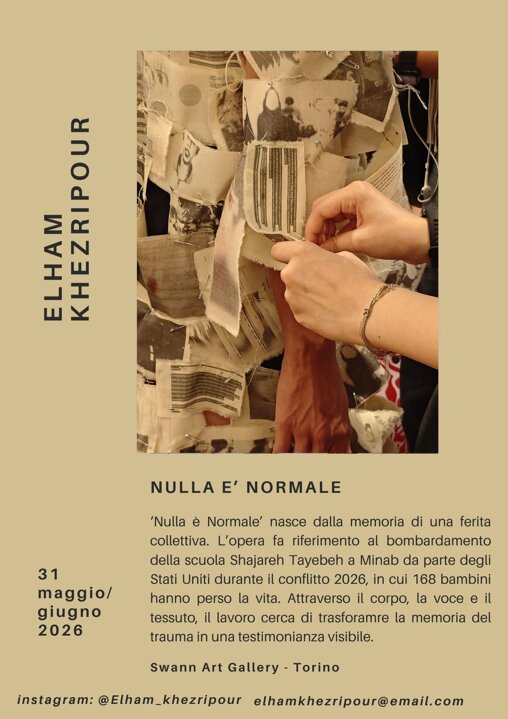
ELHAM KHEZRIPOUR
NULLA E' NORMALE
GALLERY PERFORMANCE
31/05/2026
Nulla è Normale (Nothing Is Normal) emerged as a reaction to this normalization of horror—a reflection on collective numbness and the distance human beings have created between themselves and the suffering of others. In this project, the body becomes memory and testimony; a space that preserves traces of fear, loss, contact, and survival. The garment, too, ceases to be a purely decorative element, transforming instead into a language of memory, vulnerability, and resistance.
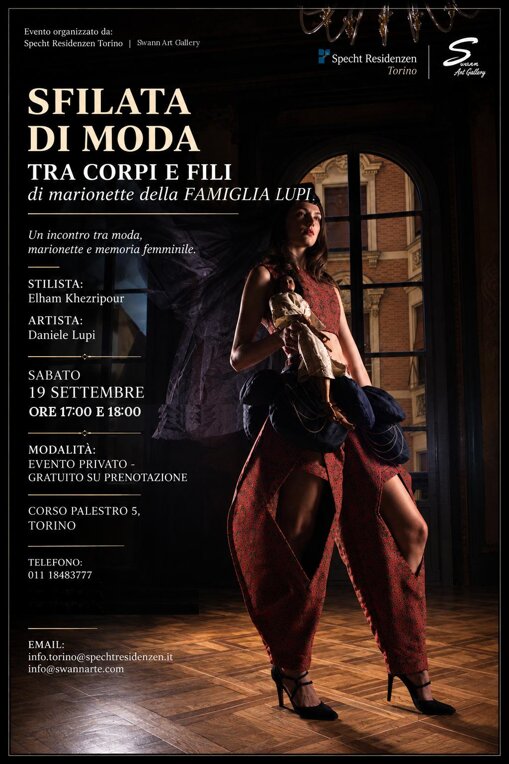
Before becoming a character, every marionette is a body in another’s hands. Many women throughout history have shared this same fate: they possessed strength and will, yet the framework of the official narrative left them no space. For this show, Eliuot has the honor of hosting the historic Turin-based marionette troupe *La Famiglia Lupi* (Daniele Lupi)—figures born of 230 years of living history in Turin—embodied here by the female characters from the mythological tale of Aida.
A marionette moves via the strings held by another hand. Similarly, the Qajar woman took shape through the court painter’s brushstrokes, the European Orientalist’s lens, and the narratives penned by men who wrote history. Neither was the author of her own self. This is the point of convergence between the two collections—not a slogan, but a form: a wooden figure moving on strings and fabric cut by another tailor’s hand share the same experience—a body whose movement was never self-determined.
In this collection, traditional Persian fabrics are torn, cut, and stitched back together so that, from the very wound of the cut, a body rises—one no longer sewn merely to be looked at. This tearing, this intentional disruption of line and cut, is the language this work has chosen to express its rage and resistance.
The marionette and the model no longer inhabit separate worlds. The puppet steps out of its state of perpetual suspension to lean against a living body—one that, in its own way, was once suspended too. In this proximity, the relationship is reversed: the fabric that was never meant to be seen becomes the support for the wooden figure that was never meant to be seen, and together, they move forward.