ARTE CONTEMPORANEA ED EVENTI CULTURALI
Swann Art Gallery
CONTATTI
Swann Art Gallery
+39 333 2455018
info@swannarte.com
Galleria d'Arte Contemporanea ed Eventi Culturali
“… La guardava; un frammento dell'affresco appariva nel viso e nel corpo di lei, e da quel momento cercò sempre di ritrovarvelo, sia che le fosse accanto o semplicemente pensasse a lei…” M. Proust
info@swannarte.com
+39 3332455018
Via Bertola 29, 10122 Torino
Via Bertola 29, 10122 Torino
Privacy Policy
Cookie Policy
©
LORENZO AVICO
SILVAE
Storie dal bosco vivente
a cura di Riccardo Dellaferrera
17/11/26 - 12/12/2026
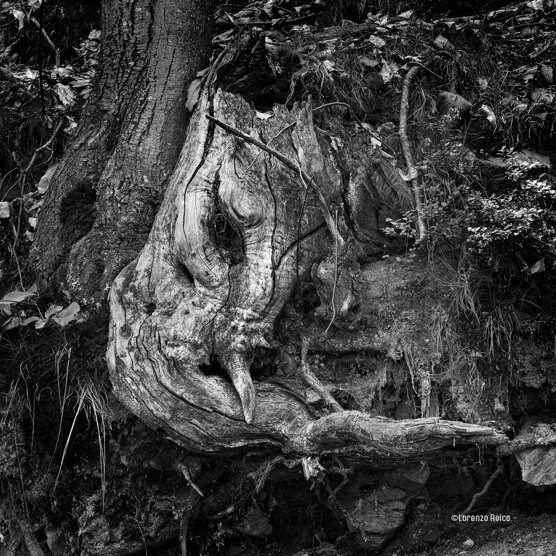
There is a moment, before any narrative begins, when sight is not yet a ‘gaze’—it is pure sensation. A glimmer of light filtering through branches, a rough surface, a shadow stretching across the forest floor—before these become images, before they become stories, they are simply this: a presence touching the retina, not yet demanding meaning. It is within this slender margin, this instant that precedes all interpretation, that the photography of Lorenzo Avico is born. It is not a pursuit of a subject, but the welcoming of a contact. Living in the woods for years—not as a backdrop, but as a home—means unlearning the haste with which we typically move through the world. It means rediscovering that nature is not ‘out there’, separate from us; rather, it is the very substance of which we are made. In this way of seeing, nature is not a landscape to be contemplated from a threshold; it is a single, unified fabric in which the human and the non-human share the same breath. This is an ancient intuition, known by many names throughout philosophical tradition: Spinoza’s ‘natura naturans’ ('naturing nature'); the divine that resides not above things, but within them; the primordial unity that Romantic thought sought in the dark depths from which all forms emerge. Yet, here, it is not a theory—it is a daily experience, composed of light, bark, moss, shadow, and silence. The use of black and white is not merely a stylistic choice, but a semantic act: stripping away color to reveal the mark, the essential—what remains when one stops describing and begins to listen. And this is why these details of the forest floor, though they never depict a human being, always bear a resemblance to one: the bifurcation of branches may evoke the gesture of two bodies reaching for each other; a crack in the bark may recall the mark of a wound we recognize. Not through arbitrary projection, but because the very form of life—whether vegetal, animal, or human—obeys a singular idea of growth, resilience, and surrender. There is nothing mystical in this union, at least not in the sense of an escape from reality; rather, it is a form of total attention—what Husserlian phenomenology would call ‘epoché’, the suspension of judgment that allows things to appear as they truly are, prior to the categories we impose upon them. It is a pantheism devoid of dogma, experienced within the body before it is conceived by the mind: the conviction that meaning is not to be sought elsewhere—in some afterlife or a future yet to be attained—but right here, in the unhurried pace of an afternoon in the woods, in the patient gaze that does not chase after time, but instead allows it to settle. And in this way, a sign—that minute trace, that ripple of light or shadow—can become a story, and that story can, ultimately, become a shared love. For to recognize in another—be it a human being or a tree—the very same living substance from which we ourselves are made, is, in itself, an act of love. In this context, the photography of Lorenzo Avico does not merely represent this bond; it bears witness to it with vividness and intensity.
Riccardo Dellaferrera