ARTE CONTEMPORANEA ED EVENTI CULTURALI
Swann Art Gallery
CONTATTI
Swann Art Gallery
+39 333 2455018
info@swannarte.com
Galleria d'Arte Contemporanea ed Eventi Culturali
“… La guardava; un frammento dell'affresco appariva nel viso e nel corpo di lei, e da quel momento cercò sempre di ritrovarvelo, sia che le fosse accanto o semplicemente pensasse a lei…” M. Proust
info@swannarte.com
+39 3332455018
Via Bertola 29, 10122 Torino
Via Bertola 29, 10122 Torino
Privacy Policy
Cookie Policy
©
STEFANO GRECO
OPERA AL NERO
atto secondo
a cura di Mario D'Amato
15/10/26 - 14/11/2026
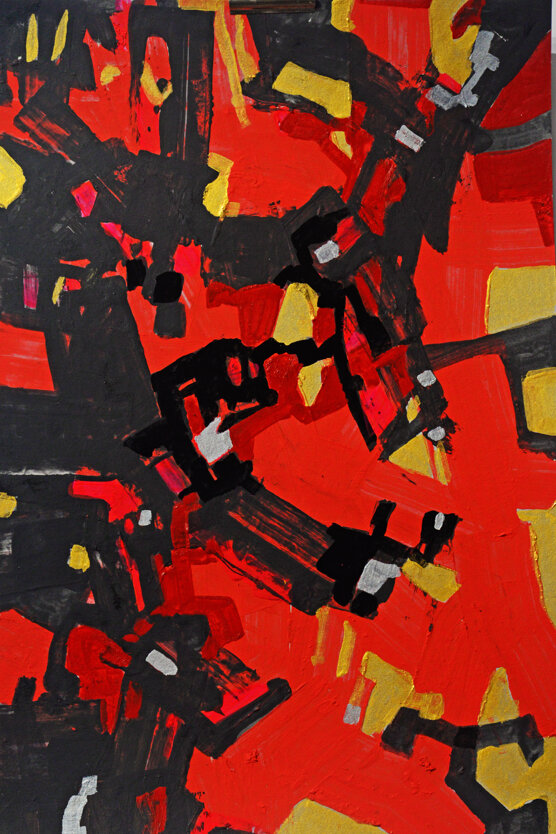
Black, the *enfant terrible* *Opera al Nero – Primo Atto* (Black Work – Act One)—a curious concept rooted in *commedia dell’arte*—was presented by the eclectic artist Stefano Greco on September 12, 1998, in the Exhibition Hall of the San Mauro Torinese Town Hall. Twenty-eight years later, *Opera al Nero – Secondo Atto* (Black Work – Act Two) premieres on October 15, 2026, at the Victor Rabbit House. The actors: Black and Light. Author and director: Stefano Greco. "In the beginning, there was black"—an infinite darkness preceding the fateful Big Bang, as hypothesized by scientific theories. The *enfant terrible* of colors, black represents—in alchemy—the initial phase of the Great Work: *Nigredo* (or *opera al nero*). This stage symbolizes decomposition, the death of the ego, and the putrefaction of the *prima materia* (raw material) required to create the Philosopher's Stone. For decades, Stefano Greco—a keen student of mythology and the occult sciences—has pursued a line of inquiry functioning as a method of creative-cognitive investigation. His work centers on the concept of otherness, the interactions between the human and the *U-mano-ide* (humanoid), and the nature-culture dialectic, translating these themes into metaphysical postulates. The ancient Egyptians depicted their gods with human bodies and animal heads, believing the human body expressed rationality and order, while the animal head symbolized the deity's supernatural essence, powers, and behaviors. In his work *Mutazione A* (2000), Greco presents a disturbing male torso—standing, emerging from, or sinking into a thick, blackish substance—and replaces the head with a left hand. Hands are "the window of the mind"—to quote Kant—for they reveal the deepest emotions and help organize and enhance thought. Historically, the left hand is associated with the unconscious, intuition, and the emotional realm; furthermore, in Eastern philosophy, it represents Yin, while in mysticism and magic, it symbolizes individualism, liberation from traditional dogmas, and the assertion of the self. It embodies a reflection on the future of society and—above all—on the ability to continue shaping creativity in a broad sense, specifically through architectural expressions or propositions. Ultimately, hand gestures serve as a snapshot of craftsmanship and of the *Évolution créatrice* (Creative Evolution) famously described by Bergson. The exhibition’s signature piece is the "portal" titled *La casa dell’Alchimista* (The Alchemist’s House, 2025). The work displays a variety of forms and panels—both rational and irrational—alongside a strange labyrinth whose entrance and exit the painter seems intent on revealing, while hinting at the path within. Drawn to the allusions and symbols of time, as well as the metaphors and harmonies of nature, the artist presents the "Second Act" of the *Opera al Nero* (Black Work). This work blazes, floods, and seduces like an empty mirror into which the remnants, rags, urgings, and impulses of lived experience and dreams—amidst a play of repetitions—sink down into the darkness of the unconscious. Stefano Greco—a creator of wonders—predominantly depicts his artifacts against a black background. This approach tends toward a *tabula rasa* effect, becoming the very condition that defines his iconographic syntax and his methodological and architectural mastery—qualities we already knew well, but which have now become even more refined. In terms of economy, the stylistic elements are few; though presented with a graphic-formal substance that occupies minimal space, they project outward—sometimes even piercing the support itself. They trigger a creative impulse that, beyond mere chromatic variation, adopts a two-dimensional structure that commands the entire visual field. In this regard, Greco’s exhibited series does not stray far from Zen poetics: the arrangement of black and void captures the essential nature of the act of creation—an expression of spirituality and emotion. This is captivatingly rendered in the 2025 diptych *Eclissi-materia oscura* (Eclipse-Dark Matter), a work that challenges art through its resistance to established aesthetics; its luminous aura celebrates a metaphysical stasis—a magical, spellbinding experience. This sense of wonder continues in *Genesi della materia* (Genesis of Matter, 2024), where labyrinthine details emerge in the background, while a vibrant cluster of whites, reds, blues, and yellows—representing nothing less than the stages of the *Magnum Opus*—bursts forth at the center. Finally, in *Dal tramonto all’alba* (From Dusk Till Dawn, 2025)—reminiscent of a celestial dial—swarms of particles, fragments of color, gold leaf, and indistinct memories of a dark era seem to orbit spontaneously around a barely suggested star. Meanwhile, in *Missing time* (2025), a yellow sun is deliberately obscured by a massive, dark brownish-black cumulonimbus cloud, streaked with shades ranging from green to matte yellow. The Initiate aspiring to the role of Alchemist undertakes a liturgy rooted in Hermetic and initiatory tradition; this tradition hands down an art aimed at transforming one’s deepest, most intimate self—often dark and heavy due to its "impurity"—into a state as brilliant and noble as gold, directed toward the fulfillment of virtue. In esoteric terms, this process is defined as *transmutation*. The work—at once epiphany and essence—unfolds through a complex web of tangles, traces, paths, symbols, obstacles, and impulses. It acts as an Ariadne’s thread leading to a coveted goal; yet, reaching that goal demands a purification of inner qualities—striving for spiritual perfection and self-realization through the process of *Solve et coagula* (2025), here visualized as a dense clot and flowing rivulets. Its almost palpable visual appearance depicts the metamorphosis of matter—both physical and spiritual—as it reassembles into a purer, more stable form; this serves as a metaphor for the universal principle driving both knowledge and evolution. The blue background shared by *Trasmutazione* and *Solve et coagula* (both from 2025) creates a connection that makes the surface resemble a gateway into matter itself; it evokes the melancholy born of despair as it shifts toward reflection—a sensation of coldness and shadow, and a—perhaps futile?—quest for the soul that leaves one unsettled. Finally, the "rare pearls" of *Nove Mantra* (2017) are displayed within a tiny *Wunderkammer*; these mantras need not merely be "recited," for often, simply "listening" to them is enough to experience their full range of beneficial properties. Thus, for the artist, color—or the absence thereof—signifies not only joy and a love for life but also anger and a denunciation of the malaise—existential, individual, social, and political—that plagues our times. Thus, Stefano Greco’s compositions simultaneously take on a dual role: they serve as mediators of meaning and inner resonance, yet they also stand as objects in their own right—possessing plasticity through newly molded materials—moving away from a personal narrative thread or a singular, guiding message toward a state of expressive plurality and openness, capable of yielding as many images of significance as there are interpretations offered by the audience. A piece can, therefore, become a city, a star, an object, matter, a god, a chimera, poetry, air, water, earth, fire… *Ça suffit*: it is all the soul requires
Mario D’Amato